Imagine you are six years old. You have been separated from your parent. Perhaps you don't know why they aren't at home or where they are, and when people talk about them, the adults start to whisper. And suddenly you are going to visit them. The adults tell you that Dad works there, or that he is staying in a hotel, or that he is a special, protected and very important person. You travel for hours, maybe through the night. Or maybe only to the other side of your own town. You stand in front of a building that looks more like a fortress than a hotel. You pass through one heavy door, then a second, then a third. Someone in uniform checks your pockets. You have to leave all your belongings in a locker, and then the next doors open onto a large room filled with the noise of many conversations. You sit with your mum at a big, empty table and wait. Dad is coming.
In 2024, 4,841 children in Croatia were separated from a parent serving a prison sentence, according to the official report on the work of the prison system. Only 1,374 of them came to visit. There are many reasons why the others did not: family poverty, distance, the cost or organisation of the journey, family circumstances. Sometimes the reason is that contact with the parent is not in the child's best interests. Some of these obstacles are hard to change, but there is one the system can change itself: making the arrival at the prison safe and child-friendly.
Salutogenic design of space
Josephine van den Ent, a Dutch interior designer and environmental psychologist who studies visiting areas in Dutch prisons, stresses that design is not decoration but communication. High fences, metal detectors, concrete, steel, long empty corridors and heavy metal doors that slam shut behind a child signal mistrust before the child has even seen their parent. Warm lighting, soft colours, sound-absorbing materials and views of plants say something entirely different: that the child is welcome and is in a safe and supportive environment.
Children say this themselves. In a 2024 survey by the European network Children of Prisoners Europe (COPE), in which 48 children from ten countries shared their views on visiting a parent, 91% said it was important to them that waiting rooms and visiting areas be child-friendly. The Council of Europe stated this in its 2018 Recommendation CM/Rec(2018)5 concerning children with imprisoned parents: children need a space where they can feel safe, welcome and respected. The Recommendation also makes clear that children's rights and good-quality contact with a parent are compatible with prison security and procedures.
Architects and prison researchers increasingly draw on salutogenic design. At its core is a sense of coherence: a space should be comprehensible (it doesn't confuse me as a visitor and I know what to expect), manageable (I can easily find my way around) and therefore meaningful. In such a space, people cope better with stress.
Applied to a prison visit: a child copes better with stress if they know what awaits them and where they are going, if they have at least a little choice and control over what happens, and if they experience the visit as time with Mum or Dad rather than a procedure to be endured. The family preparing the child for the visit can influence some of these things, but others are in the hands of the prison service alone.
Salutogenic design is often linked with two further approaches. Trauma-informed design starts from the fact that people entering a prison have often already experienced trauma, and that the space must not deepen it. This applies to children too, because the imprisonment of a parent is counted among the most adverse childhood experiences. The other approach is biophilic design, which brings nature into the space: daylight, greenery and views of the outdoors.
Child-friendly care from the point of entry
It is important to remember that the visit does not begin in the visiting room but at the entrance. At the entrance, clarity matters most: a child is less frightened when they know where they are going and what to expect. Clear signage, pictures and age-appropriate explanations help, and in some places a mascot can even guide the child through the building.
In 2019 and 2020, as part of the project Unbroken Ties which we ran with the Ministry of Justice and UNICEF, we refurbished children's visiting areas in several prisons. At Lepoglava Prison we did not stop at the visiting room but also redesigned the waiting room and the search area. At Požega Prison, visited in April 2026 by participants in the CHILD TRUST transnational training from Croatia, Italy, France and Poland, the visiting area is reached not through the prison itself but through a separate side entrance, which participants particularly praised. This way, children walk past an enclosed garden and greenery on their way to the visit, rather than through long corridors.
For children, the search at the entrance is often the hardest part of a visit. In the COPE survey, 87% of children said it was important to them that searches be child-friendly. Many wrote that during the search they felt as if they had done something wrong themselves. The Council of Europe Recommendation requires that children be searched in a child-friendly way, with respect for their dignity and privacy, and prohibits intrusive searches of children.
The visiting room
Despite European recommendations, European prisons still have visiting rooms with tables fixed to the floor, which makes it hard for a parent and child to hug, and in some places a low glass partition separates them so that they cannot even touch. With the six-year-old from the beginning of this text, a parent in such a room cannot even sit on the floor and play. We came to the same conclusion at Roda. Some children will spend much of their childhood with a father or mother in prison, unable to sit on their parent's lap or play with them on the floor. That is why, when designing visiting areas, we deliberately avoided the usual children's corner with small plastic chairs, toys and a television. Such a corner works well in a health centre waiting room, but in a room where a child spends an hour or two with their father a few times a year, it effectively separates the family: the adults talk while the child plays alone.
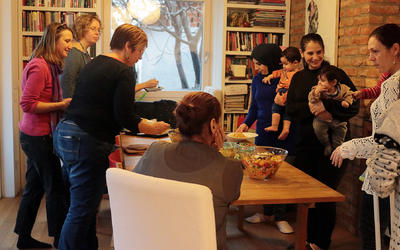
Instead, in about forty square metres at Lepoglava Prison, we created different family corners for different families, so that the space suits a two-year-old and a teenager, a family with one or two children and a family with eight siblings. There is a quieter corner for talking with an older child, a rug where little ones can roll around on the floor, and a spot for a family photo that the child can take home as a keepsake, without the prison setting being recognisable in it. Most of the furniture was made or restored by prisoners and staff of the prison's carpentry workshop.
Roda's refurbishment of the visiting area at Lepoglava Prison also reflects manageability: movable furniture and the chance for a family to choose where to sit give at least a little control in an environment where there is normally none, which helps children feel safer and more relaxed. Semi-private corners make conversation possible without the feeling of constant surveillance. Small details help too, such as drawings of animals hidden among leaves on the walls, which children can search for. The space is designed to invite conversation, whereas the usual visiting rooms with benches and chairs can feel confrontational.
Even a good space is never finished once and for all. Participants in the Požega training praised the children's visiting area, but two of them found the room for family visits somewhat cold and “clinical”. They suggested enriching the play corners with details that would make them feel warmer, while others proposed warmer and more colourful tones and private family cabins instead of a single open room.
Moving outside, where possible
In the COPE survey mentioned above, 91% of children said it was important to them to be able to spend time with their parent outdoors, for example on a walk or playing sport. At Milano-Opera prison, during the CHILD TRUST transnational training in November 2025, we saw a playground with slides and roundabouts, and outdoor visiting pavilions where families can come together, even with a dog. Next to the area there is also a kiosk where juice, pizza and ice cream can be bought.
Outdoor visiting areas also exist in Croatian prisons, such as the small atrium with seesaws at Glina Prison, or at Valtura Prison. Of course, it is not always possible to provide such spaces within old buildings, but it is important to plan for them when new prisons are designed and built.
Space should respond to children's different needs
A space that suits one child may not suit another. A fourteen-year-old boy from Sweden, who has ADHD, anxiety and depression, wrote in the COPE survey that he likes seeing his dad but finds it very hard to sit still in an empty room with no sound, and that this makes him feel as if he is the one in prison. He is worried before every visit and so tense during it that he usually falls asleep. A British good practice report from March 2026 describes a prison in Manchester that offers quieter visiting slots for people with neurodivergent needs. The Council of Europe Recommendation requires that visits be accessible to children with special needs as well.
The space also needs to suit different ages. What delights a two-year-old is often embarrassing for a teenager, such as talking at a low, colourful plastic table next to a toy kitchen or a toy workbench. That is why, alongside spaces offering the youngest children a chance to play with their dad on a rug, Roda also created a quieter corner at Lepoglava Prison where an older child can withdraw with their parent for a conversation. Research in prison systems shows that young people especially like window seats, nooks and other places at the edges of rooms, so it is important to take this into account in the design.
It is important to show children what lies “behind the wall”
A child who has never seen where their parent lives is left without an answer to the question of what that life looks like, and this lack of context and understanding can add to the stress and discomfort a child is bound to feel when visiting a prison. The Council of Europe Recommendation therefore proposes that, where it is in the child's interests, the child be able to see the place where the parent stays, including their room, or at least see photographs of it. To give children an insight into the fact that their parent is safe, Roda produced posters for all prisons. They show all the important rooms within the prison and describe their purpose, so that children, and adults too, can look at photographs of the interior of that particular prison and of the everyday life of prisoners while they are in the waiting room or visiting area: bedrooms, the kitchen, the canteen, the medical room, the library, the classroom, work areas and workshops, the garden and so on.
The space we welcome a child into is only the beginning of the visit
Even the most beautiful room does not help if the people in it do not behave in a friendly way. The Polish Prison Service has set up 152 children's corners in visiting areas, yet in 2020 the Polish Commissioner for Human Rights still had to deal with the case of a father of five who was not allowed to play with his children in such a corner, even though the children wanted to. The Prison Service subsequently instructed all regional directorates to check the rules for these corners.
To educate prison staff, we and our partners also held national trainings in all four countries as part of CHILD TRUST. We discussed how a child experiences a visit to a parent, how to carry out security procedures without frightening the child, and how to make visiting areas less intimidating. Participants recognised that a child-friendly approach can reduce children's stress and strengthen their relationship with their parent. As the biggest challenges, they named the need for ongoing training and for internal protocols for children's visits that would be more visible and applied equally in all prisons.
What we learned through CHILD TRUST
Between November 2025 and May 2026, together with partners from Italy, France and Poland, we visited one prison in each of the four countries and, at four transnational trainings, observed how children enter prison. We drew several lessons about space from this.
The space needs to be seen through a child's eyes, from entrance to exit. At Kraków Remand Prison in March 2026, participants followed the same route that children take: from the reception office, through the main entrance, to the visiting room. In discussion with the prison management, it was emphasised that working with the Małopolska Probation Association (Probacja) on child-friendly spaces is not just a visual change but systematic work and relationship building.
A visiting area does not have to be a single room. At Milano-Opera prison in Italy we saw a space they call the “cottage”, which some prisoners can be granted as a privilege, for example for children's birthdays or other important family occasions. The cottage is a larger family room with a kitchen, a dining area and a living room, where up to six family members can spend three hours. At Fleury-Mérogis prison in France, the largest prison in Europe, in May 2026 we saw play corners in family waiting rooms and special visiting rooms where a third person is present, for example a professional from the association Relais Enfants Parents or someone from the child protection service. During the visit to Požega Prison in Croatia, the visiting area for the families of women prisoners was being renovated, but participants saw the area for children's visits to their fathers, and singled out as a particular advantage the fact that, in the newly built block, the visiting area was designed right at the edge of the building, so that children do not have to pass through prison corridors.
A child-friendly prison is not a kindergarten. At the closing training in Paris, experts from Relais Enfants Parents repeated what ran through the whole project: empathy and security requirements are not in conflict. Roda's interventions in Croatia show that a space can be created in a prison where a child does not feel as if they are in prison, without giving up on security. Such a space helps a child understand where they are, gives them at least a little choice, and makes the visit what it should be: time with Mum or Dad.
In the work mentioned above, van den Ent warns that family rooms in prisons are often an afterthought, added years after construction. Spaces for children and families should therefore be part of the plan from the start, when prisons are built or renovated. They also need to be maintained and added to, and children should be asked during the design process, because they know best what frightens them and what helps. The question is no longer whether this is possible, because we have seen many examples showing that it is, but whether every child, in every prison, will get such a space.
This blog post was produced as part of the CHILD TRUST project. You can read the full COPE report on how children see visits to a parent in prison (in English) here.
Napisao/la: Roda
The CHILD TRUST Project – Children visiting parents – Training EU prison staff is funded by the European Commission through the Erasmus+ Programme.
This communication and its publications reflect solely the views of their authors and in no way represent the opinions or positions of the European Commission. The Commission cannot be held responsible for any use that may be made of the information contained herein.